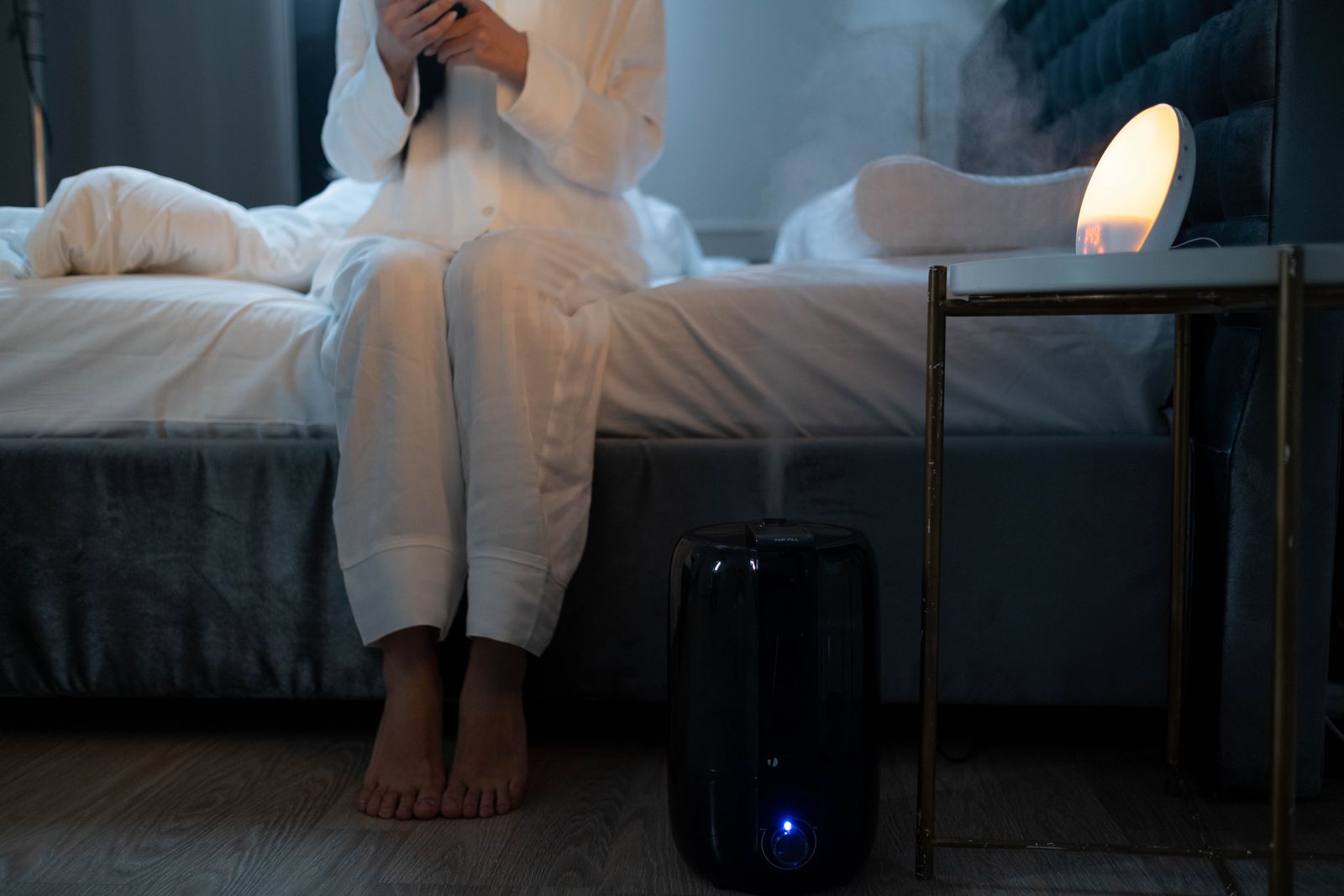
Both types raise humidity the same amount, so the choice is about everything else
A cool mist humidifier and a warm mist humidifier put the same water into the same room.
Relative humidity does not care whether the droplets arrived warm or cool.
Neither type heats a room in any meaningful way, either.
So the decision is not about performance. It is about hygiene, noise, power draw, and burn risk.
The target is the same for both: 30% to 50% relative humidity, per EPA guidance.
One design boils the water and the other does not
A warm mist unit has a heating element that brings water to a boil and releases steam.
By the time that steam has crossed a few feet of room it has cooled to near room temperature.
Cool mist comes in two forms, and people conflate them constantly.
Evaporative models draw air through a wet wick. A fan does the work and the water is never heated.
Ultrasonic models vibrate a plate millions of times a second and throw a fine fog off the water surface.
Ultrasonic is the design in most inexpensive humidifiers on shelves today.
The boiling step is the real hygiene difference
Boiling kills most bacteria and mold living in the tank before the water ever leaves the machine.
An ultrasonic unit does the opposite. It aerosolizes whatever is in the tank and delivers it to the room.
That includes dissolved minerals, which settle on nearby surfaces as white dust.
It also includes anything growing in a tank you have not scrubbed lately.
The EPA recommends distilled or demineralized water in ultrasonic and impeller humidifiers, and emptying and cleaning them every three days.
Warm mist sidesteps both problems, but it pays for that with scale.
The minerals stay behind and crust onto the heating element, so descaling becomes the recurring chore instead.
Warm mist sterilizes the water on its way out. Cool mist sterilizes nothing, which is why the cleaning schedule is not optional.
EPA guidance on humidifier use and careOfficial source — U.S. Environmental Protection Agency →
Power and safety are what usually settle it
Heating water is expensive. Moving it is not.
A heating element pulls a few hundred watts whenever it runs, which over a full winter is a line you can see on a bill.
| Cool mist (ultrasonic) | Warm mist | |
|---|---|---|
| Typical power draw | 20–40 W | 200–300 W |
| Tank bacteria | Passed into the room | Killed by boiling |
| White dust | Yes, with tap water | No |
| Noise | Nearly silent | Faint boiling, no fan |
| Hot surfaces | None | Element and water |
Evaporative cool mist sits between the two: no white dust, no hot water, but a fan you can hear and a wick to replace.
Bottom line: A warm mist humidifier holds boiling water on the floor. Pediatric guidance favors cool mist wherever small children or pets can reach the unit.
Hard water pushes the answer the other way.
If your tap leaves scale on the kettle, an ultrasonic unit will coat the nightstand in the same minerals unless you buy distilled water by the gallon.
Hybrid models run both modes from one tank, which is the compromise most people actually want.
The trade there is part count, and every extra part is another surface to clean — a point covered in the Levoit LV600S Review.
Pick warm mist for a hard-water home with no toddlers.
Pick cool mist for almost everything else, and then commit to the three-day rinse.


