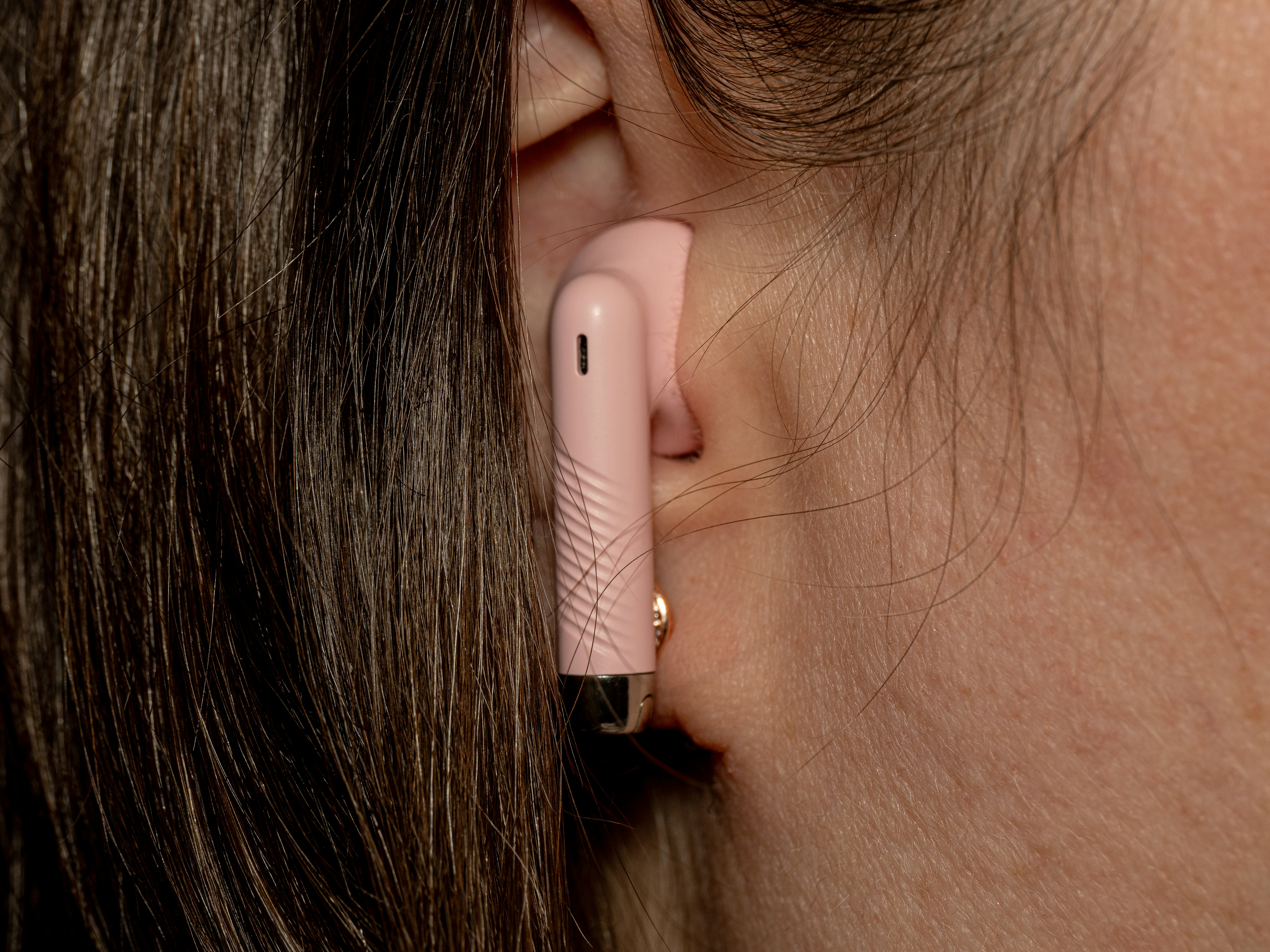
Wireless earbuds rarely fail at the speaker.
They fail at a lithium cell roughly the size of a shirt button.
That cell is why a pair that ran eight hours in 2024 cannot finish a cross-country flight in 2026.
Nothing is broken. The chemistry wore down, and a good share of that wear was avoidable.
Quick facts
- Typical usable life: 2–3 years of daily use
- Cycle rating: about 500 full cycles to 80% capacity
- Cell size per bud: roughly 40–80 mAh
- Storage: below 95°F, near 50% charge for long breaks
Heat does more damage to an earbud than charging ever will
Every lithium-ion cell carries a cycle rating.
Most are specified to hold about 80 percent of their original capacity after roughly 500 full charge cycles.
A phone battery holds around 4,000 mAh. An earbud battery is closer to 55 mAh.
Same rating, very different pace. Tiny cells empty and refill several times a day, so the cycles stack up within a year.
Heat then works on its own schedule, independent of how often you charge.
A cell parked at full charge in a warm place loses capacity even when nothing is playing.
That is the well-behaved version, with the cell kept cool. Abuse the temperature and the same curve arrives a year early.
The parked car is the worst place a charging case can sit
Interior car temperatures pass 120°F on a sunny afternoon.
Lithium cells begin taking permanent damage somewhere above 95°F, and they do not recover when things cool off.
A glovebox is not a refuge. It is the same hot air with a lid on it.
Keep the case indoors, out of direct sun, and off warm surfaces like a laptop vent or a windowsill radiator.
A cell held at full charge in a hot car ages faster sitting still than it ever does in your ears.
A case left plugged in around the clock holds the buds at 100 percent
Charging cases top the buds back up the second you drop them in. That part is doing its job.
Leaving the case itself on a charger all day and all night is the part worth changing.
The buds then sit at full voltage indefinitely, which is the state lithium tolerates least.
Charge the case, unplug it, and let it run down toward a third before you plug in again.
Shelving a pair for a few months? Leave the case near 50 percent and check on it twice a year.
Short top-ups cost you almost nothing
A charge cycle is cumulative, not one per plug-in.
Two separate 50 percent refills count as a single cycle, so returning buds to the case between calls is free.
What is expensive is draining to zero and racing back to full, over and over, while the case is warm.
You cannot really override a case that always charges to 100 percent, which is exactly why storage temperature matters more than any habit you can control.
Rated playtime figures on the box assume a fresh cell, so treat them as a ceiling rather than a promise. The published numbers on current flagships are laid out in our Sony WF-1000XM6 Review: The 5 Numbers That Decide If It's Worth $330.
Halved runtime means service, not settings
When a pair that once ran eight hours quits at four, no equalizer setting brings it back.
Some manufacturers replace the cells or swap the buds for a fee, usually well under the price of a new pair.
Ask before you shop. Battery service is rarely advertised on the product page.
One thing is not a repair question at all.
If a bud or the case looks swollen, has a bulging seam, or will not seat flat, stop using it immediately.
Do not charge it, do not puncture it, and do not put it in household trash or curbside recycling, where crushed cells start fires.
Drop it at a collection point that accepts lithium batteries.
Find how to recycle lithium-ion batteriesOfficial EPA guidance →
Two or three years is the honest expectation for a daily pair.
Keeping them cool is what decides whether you get the long end of that range or the short one.