Ordinary stereo places music between your ears.
Spatial audio tries to place it in front of you, at roughly head height, in a space with walls.
The trick is that nothing changes physically. There are still two drivers, one per ear.
What changes is the math applied before the signal reaches them.
Your ear shape is the filter the processing imitates
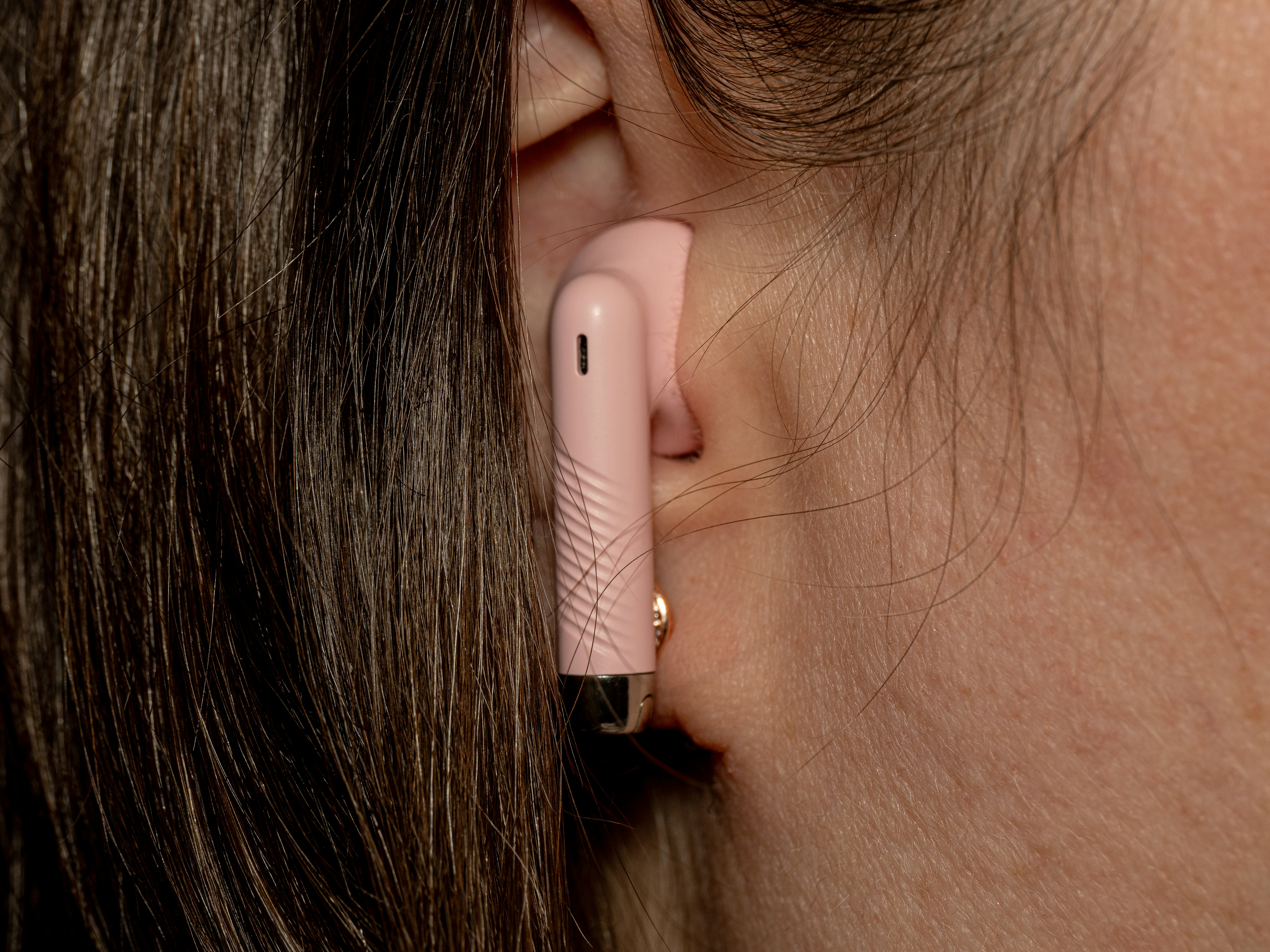
Sound arriving from your left hits the left ear a fraction of a millisecond early, and slightly louder.
It also gets bent by the folds of your outer ear on the way in.
Your brain reads those distortions as direction. That whole set of cues has a name: the head-related transfer function, or HRTF.
Spatial audio applies a modeled HRTF to each virtual speaker in a mix.
Do it convincingly and a guitar recorded to the "left rear" channel sounds like it is behind your shoulder, not inside your head.
Do it with a generic profile and the effect ranges from striking to faintly wrong, depending on whose ears you were born with.
That variability is why some people rave about spatial audio and others switch it off within a week.
Apple addresses it by scanning your ears with the phone camera to personalize the profile. Most other implementations use an average.
The illusion is built entirely out of cues your outer ear has been adding to sound since birth.
Head tracking is the half people actually hear
Static spatial audio is a fixed room. Turn your head and the room turns with you, which is exactly what a real room never does.
Head tracking fixes that by putting a gyroscope and accelerometer in the headphones.
The phone knows where the screen is. The headphones report which way you turned. The mix rotates to compensate.
Look left during a movie and the dialogue stays anchored to the display, the way it would from a soundbar.
This is the moment most listeners describe as the point they finally understood the feature.
It is also the part that needs hardware. Processing alone can be done on the phone; tracking cannot.
The flagship over-ear models carry the sensors, and our Sony WH-1000XM5 Review: 5 Numbers That Explain Why It Still Sells in 2026 walks through what else that price buys.
A real spatial mix and an upmixed one are not the same product
Dolby Atmos Music and Sony 360 Reality Audio are the two formats studios actually mix for.
In those, an engineer places each element as an object in three-dimensional space, and the renderer decides where it lands in your headphones.
Apple Music, Amazon Music Unlimited, and Tidal all carry meaningful Atmos catalogs.
What they do not carry is your entire library in that form. Most back catalog was mixed in stereo and stays that way.
For everything else, phones offer a "spatialize stereo" option that widens a two-channel track algorithmically.
That is a guess, not a mix. It often reads as extra reverb and a hollowed-out center, which is where vocals live.
If spatial audio has ever made a favorite song sound thin, an upmix was almost certainly the reason.
Judge the feature on tracks that were genuinely mixed for it.
It is not surround sound, and it is not a loudness setting
Surround sound needs five or seven physical speakers pointed at a seat.
Spatial audio needs two drivers and an accurate model of how sound reaches your eardrums.
The goal is the same. The method has nothing in common.
It is also not an enhancement in the tone-control sense. It relocates sound rather than brightening or thickening it.
Expect a wider, more distant presentation, and sometimes a quieter one, since energy that was hard-panned gets spread across a simulated room.
None of that makes headphones safer at volume. The exposure math is unchanged.
Try it on an Atmos-mixed album, with head tracking on, and give it a week.
If it still sounds like distant reverb after that, your ears disagree with the model, and plain stereo is the better setting.